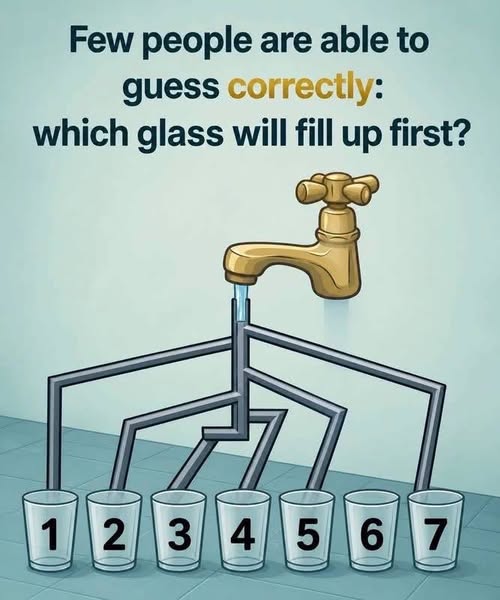
At first glance, this puzzle appears simple and even slightly obvious. A stream of water seems to flow into a system of pipes that branches toward seven numbered glasses, creating the impression that at least one of them will eventually be filled. This immediate interpretation is based on how the human brain naturally processes visual information.
When we see water and connected pipes, we expect movement to follow a logical and continuous path without interruption or blockage. Because of this expectation, many people begin solving the puzzle by tracing the water flow mentally. They follow each visible pipe, assuming that the liquid will travel smoothly through the entire system toward the glasses.
This early confidence is common in visual puzzles. The design often encourages quick assumptions, making the viewer believe that the solution is straightforward and can be reached without deep inspection or analysis.
SEE THE NEXT PAGE